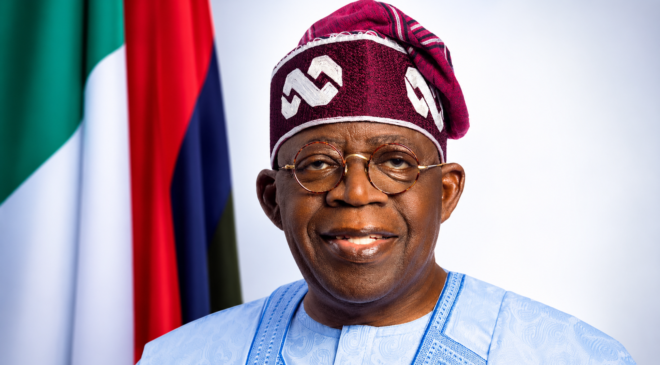
ABUJA/Nigeria: President Bola Ahmed Tinubu has called for stronger efforts to translate Nigeria’s vast natural gas resources into tangible economic value, saying resources that remain underground cannot contribute meaningfully to the country’s development.
Tinubu spoke on Wednesday when he received the board and management of Nigeria Liquefied Natural Gas Limited (NLNG), led by its Managing Director and Chief Executive Officer, Engineer Adeleye Falade, at the State House, Abuja.
The President said Nigeria must look beyond earning revenue from the international gas market and pay greater attention to how its gas resources could support domestic energy needs, stimulate economic activity and improve the welfare of citizens.
He urged NLNG to intensify efforts to reduce gas flaring and find productive uses for gas that would otherwise be wasted, arguing that such resources could be converted from an environmental burden into an economic asset.
Tinubu acknowledged the company’s contribution to the national economy and its efforts to expand production, but said the success of the gas industry should ultimately be measured by its wider impact on the Nigerian economy and citizens.
He assured the NLNG management that his administration would consider appropriate incentives capable of encouraging further investment, expansion and improved utilisation of the country’s gas resources.
The President also emphasised the need for greater domestic participation in the energy value chain, including measures that would make gas-related products and services more accessible to ordinary Nigerians.
He said the country had significant resources capable of supporting its economic ambitions, stressing that the priority should be to develop those resources and put them to productive use.
Earlier, Falade briefed the President on NLNG’s performance and ongoing expansion plans, disclosing that the company had generated more than $150 billion since inception.
He said NLNG’s shareholders had received about $47 billion in dividends, with the Federal Government holding a 49 per cent stake in the company.
According to Falade, NLNG had previously operated at about 60 per cent of its available capacity because inadequate crude oil production limited the supply of feedstock required to operate all six production trains.
He said improved crude oil production had subsequently enabled the company to raise its operations to five trains, with further increases expected as conditions in the upstream sector improve.
Falade disclosed that the company was also working towards the inauguration of Train 7, an expansion project expected to increase NLNG’s production capacity by approximately 35 per cent.
He said NLNG currently accounts for about five per cent of global LNG supply, while its LPG production is presently focused on meeting the domestic market.
The NLNG chief executive further told the President that the company’s shareholders had expressed confidence in the relative stability of Nigeria’s fiscal environment, which he said was helping to attract investment into the oil and gas sector.
He commended the security agencies and regulatory institutions for their role in sustaining the improved operating environment.
Falade also informed the President that construction of the Bonny-Bodo Road and Bridge, a major infrastructure project financed by NLNG, had been completed and was awaiting formal commissioning.
The project is expected to improve road connectivity for communities in and around Bonny and strengthen access to the area.
Other members of the NLNG delegation included Deputy Managing Director Olakunle Osobu; Board Director, Managing Director and Country Chair of TotalEnergies EP Nigeria Limited, Matthieu Bouyer; Board Director, Vice Chairman and Managing Director of Nigeria Agip Exploration, Maurizio Pinna; and General Manager, External Relations and Sustainable Development, Sophia Horsfall.
Also at the meeting were Manager, Government Relations and Regulatory Compliance, Abdul Umar; Head, Government Relations, Tonbrafa Nanaghan; and Senior Government Relations Adviser, Rufai Mohammed Lawal.
The Minister of Information and National Orientation, Mohammed Idris; Special Adviser to the President on Information and Strategy, Bayo Onanuga; and Senior Special Assistant to the President on Energy Transition, Yasmin Mohammed, also attended the meeting.