By Mokobia Rita
ASABA/Nigeria: In a strategic move to address manpower gaps and strengthen healthcare delivery, Delta State Governor, Rt. Hon. Sheriff Oborevwori, has approved the recruitment of over 700 medical and non-medical personnel across key health institutions in the state.
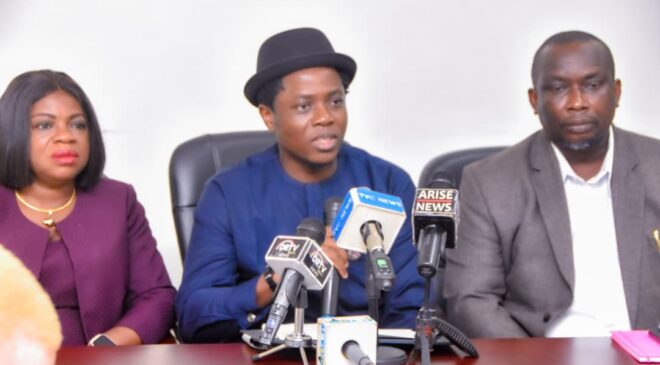
The Commissioner for Health, Dr. Joseph Onojame, disclosed this during a press briefing in Asaba, describing the development as a deliberate policy response to growing pressure on the state’s health system, particularly the impact of the ongoing migration of skilled professionals, popularly known as the “Japa syndrome.”
Dr. Onojame explained that the recruitment exercise cuts across multiple facilities under the Hospital Management Board, Delta State University Teaching Hospital (DESUTTH), the Asaba Specialist Hospital (ASH), and the newly established College of Health Technology, Ovrode.
According to him, “In the Hospital Management Board alone, 295 medical and non-medical positions have been approved. DESUTTH has 120 slots, while the College of Health Technology, Ovrode, has approval for 100 staff. Additional approvals have also been made for other facilities, including ASH.”
He noted that the policy direction is aimed at ensuring continuity in service delivery as experienced personnel exit the system, stressing that the state government has granted standing approval to replace health workers where necessary to maintain a stable workforce.
Beyond recruitment, the commissioner highlighted ongoing infrastructure expansion as part of the state’s broader healthcare reform agenda. He announced that the General Hospital in Orerokpe has been upgraded to a Central Hospital, while the Mother and Child Hospital in Ekpan, awarded in 2011, is now about 90 percent completed.
Dr. Onojame also revealed that Delta State’s contributory health scheme currently ranks among the highest in the country, with over three million enrollees, a development he said reflects growing public confidence in the state’s healthcare system.
Addressing the impact of brain drain, he said the government is taking proactive steps to bridge emerging gaps. “We have to replace critical medical and non-medical personnel to ensure that our health facilities continue to function optimally despite the migration trend,” he stated.
On specialised healthcare services, the commissioner disclosed that the state government has procured three Magnetic Resonance Imaging (MRI) machines of 1.5 Tesla Hyleon-free specification to improve diagnostic capacity across its facilities.
He further noted that a state-of-the-art public health laboratory is nearing completion and will soon be equipped for operation, adding that adequate human resources are being put in place to manage the facility effectively.
In addition, plans are underway to site a neuropsychiatric centre in Warri and its environs, with advanced arrangements already in progress to integrate services with the Osubi Specialist Hospital.
Dr. Onojame outlined that the recruitment will cover various professional cadres, including medical consultants, senior medical officers, nursing officers, and other support staff, ensuring a comprehensive strengthening of the healthcare workforce.
Responding to concerns about the quality of personnel to be recruited, he assured that the process would prioritise competence and professionalism, noting that the government remains committed to sustaining standards in healthcare delivery.
The latest approvals, he said, underscore Governor Oborevwori’s commitment to repositioning the health sector through a combination of workforce expansion, infrastructure upgrade, and investment in modern medical equipment.
Observers say the initiative signals a broader policy shift aimed at building resilience within the state’s healthcare system amid evolving challenges in Nigeria’s medical landscape.